Food Forests Explained: Designing a Self-Sustaining Edible Landscape
October 4, 2026
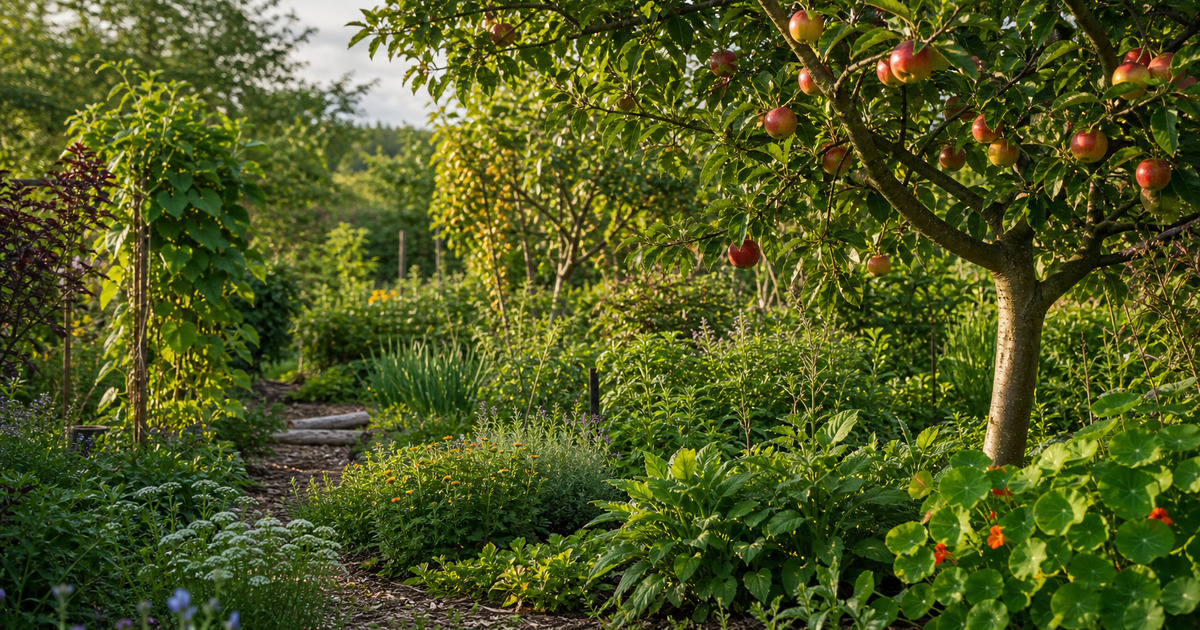
A food forest is a style of gardening that mimics the structure of a natural forest ecosystem while producing food for humans — combining fruit and nut trees, berry shrubs, herbs, and ground-level edibles into layered, largely self-sustaining plantings. Rooted in permaculture design principles, food forests aim to reduce long-term maintenance while increasing yield diversity and ecological resilience.
The Seven Layers of a Food Forest
| Layer | Examples |
|---|---|
| Canopy (tall trees) | Chestnut, walnut, large fruit trees |
| Understory (small trees) | Dwarf apple, fig, pawpaw |
| Shrub layer | Currants, blueberries, elderberry |
| Herbaceous layer | Perennial herbs, rhubarb, comfrey |
| Groundcover layer | Strawberries, clover, creeping thyme |
| Root layer | Perennial root vegetables, garlic |
| Vine layer | Grapes, kiwi, climbing berries |
Why Food Forests Work
By stacking plants across multiple vertical layers, a food forest makes efficient use of limited space and light while creating a diverse, resilient system. Many food forest designs also incorporate nitrogen-fixing plants and dynamic accumulators (plants that draw nutrients up from deep soil) to reduce the need for external fertilizer over time.
Food Forests vs. Traditional Vegetable Gardens
| Factor | Food Forest | Traditional Vegetable Garden |
|---|---|---|
| Plant lifespan | Mostly perennial | Mostly annual, replanted yearly |
| Maintenance over time | Decreases as system matures | Consistent, season to season |
| Establishment time | Years to reach full production | Weeks to months per crop |
| Yield diversity | High (many species, layers) | Moderate (depends on planning) |
| Soil disturbance | Minimal after establishment | Regular tilling/planting |
Starting a Small-Scale Food Forest
- Start with the canopy layer — plant your main fruit or nut trees first, since they take the longest to mature.
- Fill in understory and shrub layers in the years following, using the tree canopy's eventual shade pattern as a guide.
- Add nitrogen-fixing support plants like clover or certain shrub legumes to build soil fertility over time.
- Layer in groundcovers and herbs to suppress weeds and make full use of ground-level space.
- Mulch heavily in the early years to build soil organic matter while the system establishes.
Realistic Expectations for Beginners
Food forests are a long-term investment — meaningful production, particularly from tree layers, often takes 3–7 years to establish. A small backyard version scaled to a single tree with surrounding shrub and groundcover layers is a realistic and achievable starting point for most home gardeners, rather than attempting a large multi-acre design immediately.
Key Takeaways
- Food forests use a layered, permaculture-based design mimicking natural forest structure to produce food.
- Establishing the canopy (tree) layer first, then filling in shrub, herb, and groundcover layers, is the standard approach.
- Nitrogen-fixing plants help reduce long-term fertilizer needs as the system matures.
- Meaningful yields typically take several years to develop, especially from tree-layer crops.
FAQ
How much space do I need to start a food forest? Even a single fruit tree with surrounding shrub, herb, and groundcover layers can function as a small-scale food forest — you don't need acreage to apply the concept.
How long before a food forest becomes low-maintenance? Most designs need active management for the first 3–5 years while the canopy and shrub layers establish; maintenance typically decreases significantly after that as the system matures.
Is a food forest the same as permaculture? A food forest is one specific application of permaculture design principles, focused on layered edible plantings, though permaculture as a broader philosophy applies to many other systems beyond food forests.
Can a food forest work in a small urban backyard? Yes — scaled-down versions using dwarf fruit trees and compact shrub layers can fit small urban lots, though full seven-layer designs are more common in larger spaces.
Suggested Related Articles
- Backyard Fruit Tree Planting Guide
- Why Native Plants Matter: Building a Biodiversity-Friendly Garden
- Companion Planting Guide: What to Grow Together (and What to Avoid)
- Composting 101: Turn Kitchen Scraps Into Garden Gold
Internal Linking Suggestions
- Link "fruit trees" to the backyard fruit tree planting guide
- Link "nitrogen-fixing" to the companion planting guide
- Link "native plants" to the native plants and biodiversity article
AI Image Generation Prompt
A lush, layered backyard food forest with a mature fruit tree canopy, berry shrubs beneath, and strawberries and herbs covering the ground layer, dappled afternoon sunlight filtering through leaves, photorealistic, rich green and fruit-colored tones, wide shot with shallow depth of field, editorial permaculture-magazine style with negative space at the top for text overlay. Do not include any text, logos, or watermarks.
Disclaimer
This article offers general guidance. Suitable food forest plant layers and design vary significantly by climate, region, and available space — adapt this approach to your own growing environment.